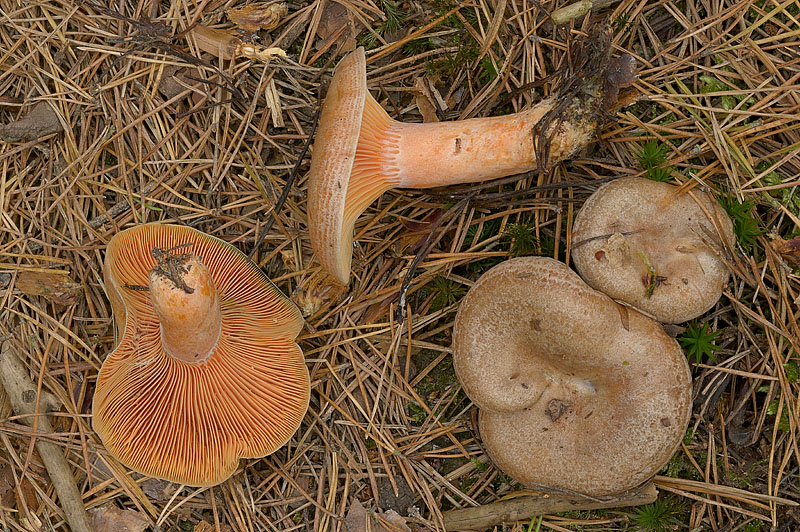
10 October 2025 Minley Wood, Hampshire. Photograph copyright Leif Goodwin. Common Name Saffron milk cap Cap Convex to expanded with a depressed centre and turned down margin, smooth, viscid, carrot orange, with numerous small darker spots often creating a zoned impression, sometimes stained greenish where bruised, to about 11 cm across Gills Decurrent, crowded, sometimes forked, carrot orange Stem Cylindrical or narrowing towards the base, hollow, pale orange, with irregular darker pits, sometimes stained greenish where bruised Flesh Firm, exuding orange milk which may on exposure to air turn red after thirty minutes or more Smell Indistinct Taste Mild Season Autumn Distribution Common Habitat On acidic soil with pine trees Microscopic Features Spores broadly ellipsoidal to ellipsoidal (8-10.5) x (6.5-8) µm2, Q = (1.1-1.4), with an irregular network of warts and ridges to 0.5 µm high. Edibility Edible, excellent. The careless collector could confuse this species with the poisonous Lactarius torminosus. Notes There are several similar species with orange caps and orange milk. The less frequently recorded L. semisanguifluus and L. quieticolor are associated with Pine. The rather common L. deterrimus is associated with spruce. These species are described in The genus Lactarius in the Fungi of Northern Europe series, and in other specialist literature. 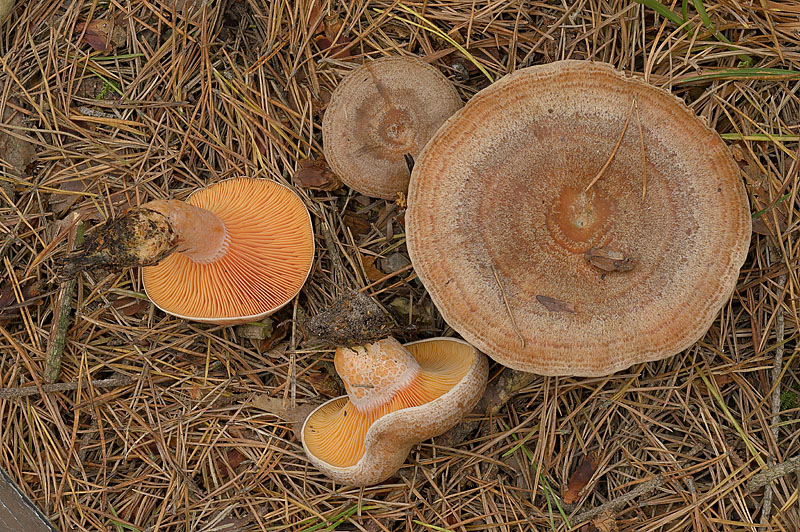
10 October 2025 Minley Wood, Hampshire. Photograph copyright Leif Goodwin. 
Spores in Melzer's solution viewed with a 100X immersion objective. 10 October 2025 Minley Wood, Hampshire. Photograph copyright Leif Goodwin. 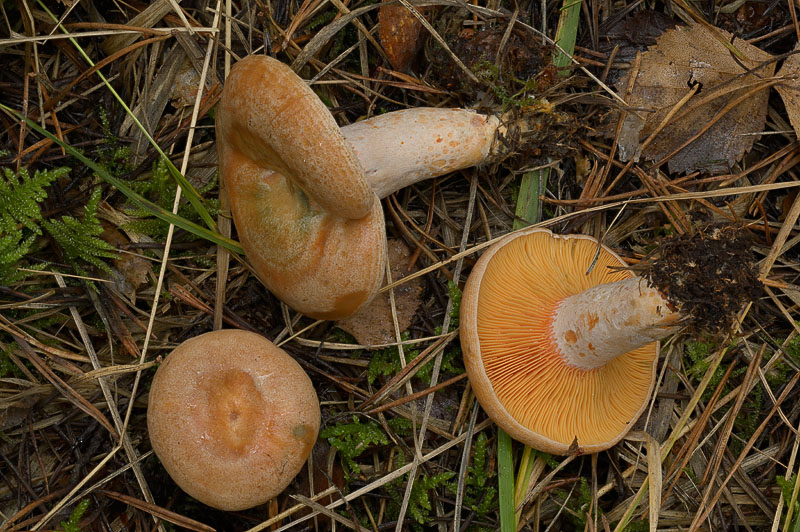
4 October 2022 Minley Wood, Hampshire. Photograph copyright Leif Goodwin. |